Showing posts with label M. W. Hilton-Simpson. Show all posts

Thursday, April 2, 2009

MEDICAL AND SURGICAL METHODS OF ISHAWIYEN


Hi, metta hallem/t,
The book describes the medical and surgical methods of Ishawiyen of Aures, Algeria. The title of the book is misleading. It seems to me that the world ARAB here means TRADITIONAL.

With our thanks to the University of Toronto!

Arab Medicine and Surgery

A Study of the Healing Art in Algeria

M. W. Hilton-Simpson (1922)


Saturday, February 28, 2009

Among the Hill Folk of Algeria: Journeys Among the Shawia of the Aures Mountains

By: M. W. Hilton-Simpson (1921).

With our thanks to the University of Toronto!


Wednesday, November 7, 2007

An Old Documentary on Ishawiyen


Hi, metta hallem/t,
I came across this item of interest. Titled AN UNKNOWN RACE, the film records some cultural aspects of Ishawiyen.

AMNH Research Library
Title An unknown race [videorecording]
Publisher New York : American Museum of Natural History, 1924.
Description : 1 videocassette (36 min.) : si., b&w ; 3/4 in.
Series : [Film Collection ; no. 283]

Note : Original format: 35 mm. negative.
Credits : John A. Haeseler, photographer.

SUMMARY
John A. Haeseler and Captain Melville William Hilton-Simpson, fellows of the Royal Geographic Society, made this film, which records the culture of the Berbers of the Aures Mountains of Algeria. The impenetrable massif of the Aures Mountains has helped the Berber people maintain their ancient manners and customs. This film depicts the geography of the Aures, Roman ruins at Timgad, the Tighanimine gorge, and the villages built on the tops of escarpments overlooking the Sahara with only a narrow, tortuously steep access route. Women of the fair-skinned Shawiya tribe of Berber stock, are seen grinding grain on a quern stone; combing, carding, and spinning wool; making pottery; and scrubbing laundry on stone by "dancing" on the cloth. They are also seen involved in the difficult task of fetching water up to the village. Children are depicted playing knucklebone, a jacks-like game, and what appears to be hockey. The men are seen irrigating their gardens by means of a water "clock," a copper bowl with a minute hole in its bottom, which is placed on top of water in a large bowl. It takes about fifteen minutes to sink. The number of sinkings is determined by the individual irrigation rights. After the alloted amount, the irrigation ditch (seggia) is dammed to divert the flow of water to another garden. The granaries are seen with their defensible facades. A man fashions wooden door locks with an adze (a cutting tool), while others tend goat herds, prepare snuff, and braid cord. This is one of the earliest ethnographic films made. Haeseler had been thinking about recording disappearing cultures on film and his association with Hilton-Simpson, during his years of studying the Berbers, proved a most timely and valuable relationship for both. The film is rich in detail, particularly in the weaving and pottery sequences.

Monday, February 5, 2007

Tradional Methods Of Making Olive Oil In Aures

Two Primitive Algerian Oil Mills.
M. W. Hilton-Simpson
Man, Vol. 20, Aug., 1920 (Aug., 1920), pp. 113-116


Monday, December 11, 2006

ShawiBib : The People Of The Aures Massif

The People of the Aures Massif
M. W. Hilton-Simpson
Geographical Journal, Vol. 65, No. 1 (Jan., 1925), pp. 24-28

Thursday, November 30, 2006

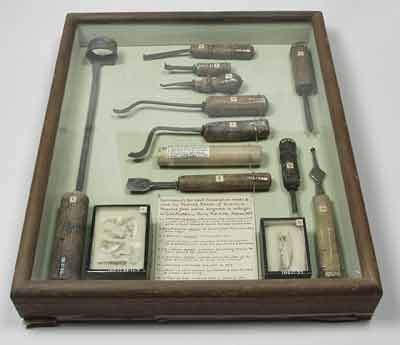
Old Surgical Instruments Of Aures


Source : surgical instruments

"Anthropologists in the early twentieth century reported that trepanation was still occurring in a number of places, notably Algeria, elsewhere in Africa, Bolivia, Peru, and Oceania. Although it is a relatively difficult and delicate procedure, survival rates reported by anthropologists, and skulls from archaeological contexts showing post-operative healing, suggest an impressive rate of success. The trepanation tools pictured below were collected in the Aurès (east Atlas) Mountains in Algeria. They were donated to the Museum in 1913. With the tools (in a small box at the bottom of the picture) there are also small pieces of bone taken from a man’s skull during a trepanation operation."

..............................................

Please note the sources of the Article:

HILTON SIMPSON, MELVILLE, ‘Some Arab and Shawia Remedies and Notes on the Trepanning of the Skull in Algeria’, Journal of the Royal Anthropological Society of Great Britain and Ireland, Vol 43 (1913), pp. 706–721.

KIRKUP, JOHN, ‘Shawiya Berber Surgical Instruments in the Aures Mountains, 1913-1922’, Congress Proceedings of the International Society for History of Medicine (1998).

For other works by HILTON SIMPSON,check out this

Monday, October 2, 2006

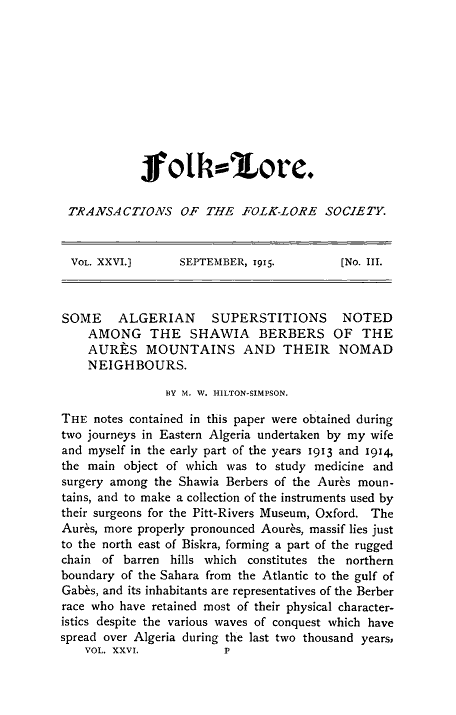
ShawiBib : Some Algerian Superstitions Noted among the Shawia Berbers of the Aures Mountains and Their Nomad Neighbours


Some Algerian Superstitions Noted among the Shawia Berbers of the Aures Mountains and Their Nomad Neighbours
By : M. W. Hilton-Simpson
Folklore, Vol. 26, No. 3 (Sep. 30, 1915), pp. 225-254.

Works by M. W. Hilton-Simpson
-Among the hill-folk of Algeria : journeys among the Shawia of the Aures mountains
Publisher : T. Fisher Unwin, 1921.

-Arab Medicine and Surgery: A Study of the Healing Art in Algeria
Publisher : Oxford University Press, 1922.

-Many articles about Aures/Ishawiyen. Published in Folklore and Geographical Journal.

© 2006-2012 Awal_nu_Shawi