Tuesday, October 31, 2006

Tighawsiwin n lellu...Things of beauty

Boubaker Laghrour

Boubaker Laghrour is a sculptor who works primarily in clay. He apprenticed under Paul Lucchesi at the Educational Alliance in New York City and has taught sculpture to adults and children. Mr. Laghrour comes to sculpture from his childhood in the Aures Mountains of Algeria where his mother made clay pots and utensils for her use in the home. In Algeria and later in the United States he studied chemistry, attaining a Masters in Chemical Engineering and working in the field. But then he discovered his passion for sculpture and his career took off in new directions. In his classes individual interpretation of the figure and study of human expression are emphasized. Mr. Laghrour's work has been exhibited at several galleries in Manhattan, including the Cork Gallery at Lincoln Center and the Tassili Gallery.

Monday, October 30, 2006

Spotlight on Aissa Brahimi : A Gentle Revolutionary

Educator, poet, musician and producer, Aissa Brahimi was born in wed el ma, ighzer n wamen, Aures (16.8.1961) . He did his primary school in wed elma, his junior high in Merouana, then moved to Batna where he attended Lycee Benboulaid.

After finishing school, Aissa entered the field of education as a teacher. He spent a few years working in the region of Bedjaia, then returned to his native Aures where he worked as teacher of music and arts. It was there that his music career took off.

He started working with some of his students, then extended his musical activities to the community at large. He helped found the band imnayen(which became Massinissa), then went solo.

In addition to his work, community work, Aissa managed to produce three albums and is in the process of finishing his forth.

Aissa Brahimi lives in wed elma, where he works as the director of the cultural center.

Machi hemma is a song from Aissa's third album. A lovely song of reflections and meditations on life. A song with a bluezy feel.


Machi hemma

machi hemma snegh thamedourth
machi hemma tennadh thmurth
matta issahen g'awalen uchigh
matta issahen g'mattawn iligh

idouyeth w'alli yenghith u'xemmem
h'atha yelés yenghith u'demmem
udh'yelli lwali adibedden fella
aiyni rouh,aiyni wella

magher hemma theqqen thegouma
uzlegh ulifegh la icht dhouma
ah arabbi rexfed ghen
gayed ennoub makche n'youdhen

matta iligh,matta ouligh
dhi thmedourth matta sawigh
magher hemma ikrés l'hal
swigh alili, awal u thennigh.


Shawi Blues

This is not the way I envisioned life
Why is it upside down
What is the point of the speeches I made
What is the point of the tears I shed.

Clouds hover over my thinking
The tongue is paralyzed by praying
No kin to look after me
Nowhere to be found.

Why is it that everything reached a dead end
I ran seeking the unattainable friend
Oh, God have mercy on us
It is time for mine.

Look to what I was and to what I became
What did I achieve in this life
Why is it that hopelessness became a way of life
In silence I drank the bitterness of life.


S Tafransist*

Ce n'est pas ainsi que je connais le monde,
La terre ne tourne plus dans le bon sens,
Qu'est-ce que j'ai récolté en donnant ma parole,
Qu'est-ce que j'ai récolté de mes pleurs.

Le cerveau est paralysé, meurtri par la souffrance,
Et la langue meurtrie par les prières,
J'aurais aimé être entouré par mes proches,
J'ai tellement souffert pour retrouver un frère.

J'aurais aimé être guidé par eux,
Pourquoi n'y a t-il pas d'issu,
Ô, mon dieu lâche un peu de mou,
Donnes moi une part comme pour les autres.

Comment j'étais, comment je suis devenu,
Dites moi ce que je vaux dans ce monde,
Pourquoi n'existe t-il pas de trêve,
J'ai subi l'amer sans dire un mot.


*Please note that the French translation is by Awal, first appeared in aurschaouia/forum.
Sunday, October 29, 2006

Symmetry in the Life of the Aurès Chaouia Tribes

Symmetry in the Life of the Aurès Chaouia Tribes

Nourredine Benali-Cherif, Institut des Sciences Exactes, Technologie et Informatique, Centre Universitaire de Khenchela. 40000-Khenchela, Algérie.


Chaouias, free, proud and rebellious tribes of Aurès, live in the south-east of Algeria. The influence that they exert in the fields of the history, art, poetry, the culture in general... is not any more to show: pottery, carpets, sculpture, architecture, painting, songs, dances, tattooings and Silver jewels. Symmetry is omnipresent in the life of Chaouias, on the splendid carpets of Nememchas, Tchouchanats of tattooed Azriyat of the Oued Abdi with richly coloured M’lahfat. The symmetrical forms and the periodic drawings of Chaouias crossed the centuries, transmitted without the least wrinkle from generation to generation, in spite of the passage of the Romans, Arabic, Turkish and French.

Keywords: Chaouia, Aurès, symmetry.

Friday, October 27, 2006

Vocabulaire de la langue Showiah

Metta hallem/t,

Hope you all had a happy laid ameziane!

This shawi text goes back to 1738. Except for a few words, the vocabulary is still in use today.

Source : Thomas SHAW, Travels and observations relating to several parts of Barbary and the Levant, Oxford, 1738.

In : Vol. II, pp. 134-136 de l’édition française, 1843.

Read

Sunday, October 22, 2006

Larbi Boulbina


Larbi Boulbina was born in 1966 in the Aures region. His areas of interests are theatre, cinema and poetry.

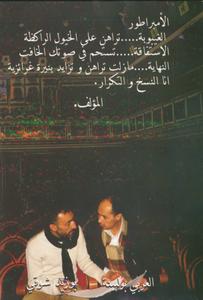
Mr. Boulbina is very known in the national theatre circle. He wrote several plays for the theatre regional de Batna. He wrote the script for the play el ambrator produced by Bouzid Chouki.

In an interview with latti3ad n Tshawit, Larbi revealed that he wrote 2 scripts in Tashawit. One script was made into a play titled ifri(1991). The second script is about Jermouni. The Jermouni script is not produced yet.

Happy laid ameziane to all!

Friday, October 20, 2006

Notes sur le chaouia de la province de Constantine

Rene BASSET
Notes sur le chaouia de la province de Constantine
Journal Asiatique 9/8: 361-94(1896)

Read

Thursday, October 19, 2006

amk qqaren di TmureT

-TamagherT yewwit usuf, Taqqar assugguess yeHla.
While being swept away by the river, the old lady said : this is a good year.
In other words, seeing the positive in the worst case senario :)

-awal am w-udem n lbarod.
The word is like a bullet.
In other words, once you said something, you have no control over it. Or amk qqaren s TangliziT, like they say in English, "you cannot un-ring a bell."

Wednesday, October 18, 2006

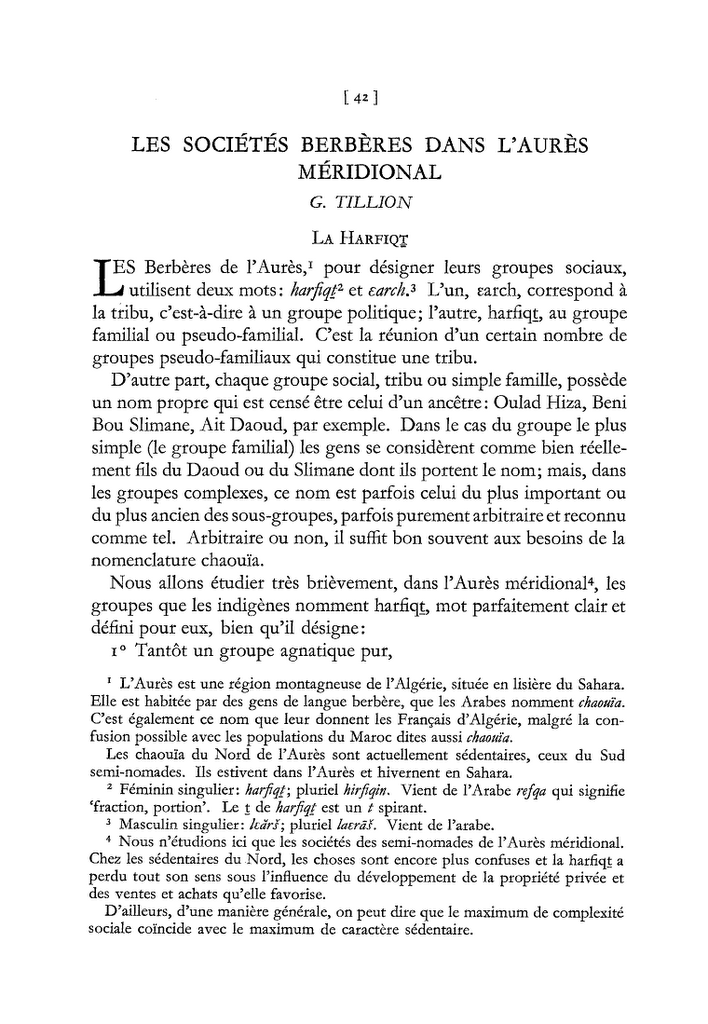
ShawiBib : Les Societes Berberes dans l'Aures Meridional


Les Societes Berberes dans l'Aures Meridional. La Harfiqt
By : G. Tillion
Africa: Journal of the International African Institute, Vol. 11, No. 1 (Jan., 1938), pp. 42-54

Tuesday, October 17, 2006

a miss n tmureT inugh


Listen, esghed a miss n tmureT inugh

a miss n tmurT inugh
zrigh imattawan nnek
a chek Tilled wa ad3adane
khammem dug adecha nnek

anezgum nnek iban
..........., Tarsek di Tittaw

..............abrid'
lakhyal ighattaT w a3law

ekker............
erfed ikhf nnek di la3la
babak yejjeked awal
TamureT i chek et walla

Dzayer nnek i chek d umek
Jerjera, Hoggar, d l'Aures
aguel nnek, ekker beddess
f lHormeT chek d-a3assess

Monday, October 16, 2006

Mémoire d’Aïn Beïda

Source : El Watan - 10 octobre 2006

Mémoire d’Aïn Beïda
(Essai) - Éditions Dar El Houda, Aïn M’lila, 2006

L’écrivain et néanmoins poète Sellah Derradji Yacine s’est déjà illustré sur la scène éditoriale algérienne avec Evasions sur les dunes, un florilège de poèmes, édité en 2003 par l’Union des écrivains algériens, sous l’égide du ministère de la Culture, et ce, dans le cadre de l’Année de l’Algérie en France.

Fraîchement sorti à la retraite, après une carrière de cadre supérieur exercé dans plusieurs régions de l’Algérie, M. Sellah s’est adonné à son violon d’Ingres, sa passion de toujours, l’écriture. Et ce qu’il y a d’original dans ce qu’il écrit ou compose, c’est sa propension à tout rédiger en quatrains avec une sobriété et une délicatesse peu communes. C’est dans ce sens qu’il a élaboré Mémoire d’Aïn Beïda, un livre riche de 224 pages, édité à compte d’auteur chez Dar El Houda de Aïn M’lila.

Pourquoi, se demanderaient d’aucuns, un tel ouvrage sur la ville de Aïn Beïda ? En quatrième page de couverture, il y est écrit que « Aïn Beïda a toujours été un carrefour géostratégique privilégié et le grand axe de l’Afrique du Nord vers l’Europe d’une part et l’Afrique noire d’autre part. » Autant dire que la cité des Haractas offre des particularités à nulle autre pareille. Depuis toujours, Aïn Beïda s’est illustrée, à travers ses habitants, par une hospitalité, devenue légendaire, tout comme elle exerce sur le visiteur un attrait particulier.

Dans son avant-propos, l’auteur avertit que son ouvrage n’a pas la prétention d’aller dans les profonds détails de l’histoire, mais se limite seulement à mettre en exergue les aspects positifs de la ville et de ses habitants, en l’occurrence la personnalité harkatie. L’ouvrage comprend dix chapitres ou parties, portant chacun un titre tels que Signes identitaires, Géographie et histoire, Valeurs et signes distinctifs, Sagesses harkaties, contes d’antan… Comme signalé, tout l’ouvrage est écrit en vers, des quatrains au néoclassisme de bon aloi.

En somme, ce livre se lit avec plaisir, tant il renferme des sommes de souvenirs, d’anecdotes aussi bien savantes que truculentes de sagesse et gorgées de nostalgie, signe d’un attachement aux valeurs intrinsèques du terroir. Sellah a réussi la gageure de créer un trait d’union entre les générations, grâce à un livre plein de saveur et d’intelligence. Son livre Mémoire d’Aïn Beïda regorge d’informations aussi bien historiques que sociologiques ou culturelles et s’adresse à tout lecteur curieux de connaître un pan, somme toute exhaustif, du patrimoine des Haractas.

Historiens et sociologues y trouveraient aussi leur compte. Mémoire d’Aïn Beïda est un ouvrage à lire absolument, tant il recèle une foultitude de détails qui suscitent l’intérêt de tout lecteur passionné d’histoire. Sellah Derradji Yacine se prépare à faire paraître sept autres livres traitant de divers sujets. Bonne continuation à l’auteur dans cette louable entreprise qu’est l’écriture !
L. Baâziz

Sunday, October 15, 2006

Ait zik nnen : proverbial wisdom

-wa egallen yejjesed babas Tsawant, et yali
If one inherits a challenge, he must confront it.

-ittedef jer n yicher d w-aksum

Amawal

  • Tsawant : uphill
  • jer : between
  • aksum : meat
  • icher : nail(finger)
  • ittedef : enters/gets involved
  • yejjesed : left him(babas)

Thursday, October 12, 2006

ussen n temzi

By Aissa Brahimi


ani roHan 3addan ussen n temzi
cha ssissen yizid, cha yerzag

u lakhseghch lHal ad imaDrane
u lakhsaghch lamr ad yerzag


Where did the childhood days go?
Some days were sweet, some were bitter

I don't want life to change
I don't want the situation to get bitter

Wednesday, October 11, 2006

Aghrib

Band : Amadiaz
Song : Aghrib

Enjoy, aghrib : amadiaz song5

Aghrib

abrid yezgar
yitchiT ussalless
udem n yema
yighattaT usagra
ah ay argazen
melmi ad iwalla wass
aTgharba di Tmura
TlaTin assugass
swigh lkass yerzagan
wa erwigh amassess
zrigh err, gginess afellass
akd jaref imall
u yguir dug ass

nech d-aghrib u d-abarrani
abrid n yiD ay 3arqan
ya zerfa walma chem ay Harqan

ul inugh yichur, mani adu3igh
zalgan wussen, mani ed walligh
ya zerfa walma chem ay Harqan

nech d-agujil nech d-agujil
ya zerfa walma umam d-aguellil
ya zerfa walma chem ay Harqan

Tuesday, October 10, 2006

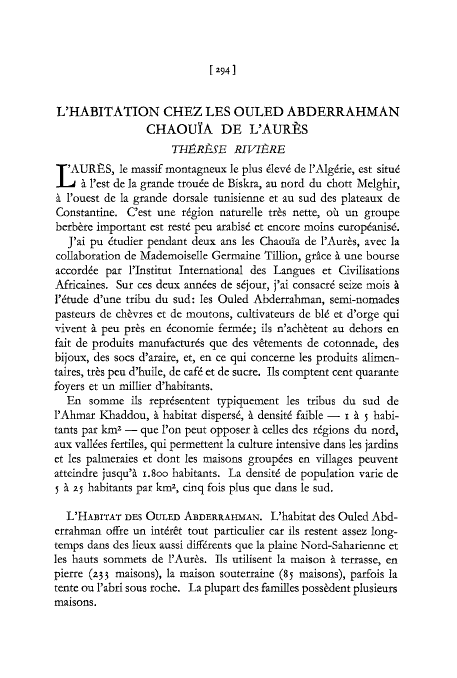
ShawiBib : L'Habitation Chez les Ouled Abderrahman Chaouia de l'Aures


L'Habitation Chez les Ouled Abderrahman Chaouia de l'Aures
By : Therese Riviere
Africa: Journal of the International African Institute, Vol. 11, No. 3 (Jul., 1938), pp. 294-311.

Thursday, October 5, 2006

Azetta


Title: Recherches sur le vocabulaire du tissage en Afrique du Nord
Author: James Bynon
Series: Berber Studies Volume11, 2005.

The present 11th volume of the “Berber Studies” series is dedicated to the publication of James Bynon’s dissertation in which the description of weaving techniques plays a central role.

This comparative linguistic work in particular deals with the different components of the weaving technique in the Berber languages of North Africa. The following areas are analysed: Morocco, North Algeria and the algerian Sahara, Kabylia, the Aurès mountains, Lybia and Egypt.

The author is a long-standing member of the research group of the renowned School of Oriental and African Studies (SOAS) of London University, where for the last 28 years he devoted his time to study and describe the languages, cultures and art of the Berber peoples.

In the 1960s, Bynon prepared his dissertation under supervision of Prof. Lionel Galand (Ecole Nationale des Langues Orientales Vivantes, Paris) and completed it in 1963.

Up to now his work had not been published. Nevertheless, berberologists who had the opportunity to cast a glance at it consider Bynons thesis as a standard work within this area. Even after 40 years have passed since its completion it deserves its present publication, not only because of the unique linguistic approach but also because of its solid scientific methodology-From the publiser.


I haven't read the book, but it looks very interesting. Anyone familiar with the book? Please let us know.

Having said that, I would like to use this post as departure point to talk about the shawi vocabulary related to the art of Azetta. Contributions are welcomed. And while you are thinking about the subject of azetta, enjoy azetta-song1 n Mihoub ennegh.

Amawal

  • azetta : the art/profession of weaving
  • amsheD : comb
  • ddofT : wool
  • hasennarT/TasennarT : spindle
  • asghun : rope
  • falu : string
  • afejjef : stopper rod
  • afejjej anijey : upper fejjej
  • afejjej anedday : lower fejjej
  • aqardech : cardage

Monday, October 2, 2006

ShawiBib : Some Algerian Superstitions Noted among the Shawia Berbers of the Aures Mountains and Their Nomad Neighbours


Some Algerian Superstitions Noted among the Shawia Berbers of the Aures Mountains and Their Nomad Neighbours
By : M. W. Hilton-Simpson
Folklore, Vol. 26, No. 3 (Sep. 30, 1915), pp. 225-254.

Works by M. W. Hilton-Simpson
-Among the hill-folk of Algeria : journeys among the Shawia of the Aures mountains
Publisher : T. Fisher Unwin, 1921.

-Arab Medicine and Surgery: A Study of the Healing Art in Algeria
Publisher : Oxford University Press, 1922.

-Many articles about Aures/Ishawiyen. Published in Folklore and Geographical Journal.

© 2006-2012 Awal_nu_Shawi